The train-test Split
- Training Data: Used to fit model
- Test Data: Used to check generalization error
- How to split? Randomly, Temporally, Geographically (Usually Random)
- What size? Larger training set = more complex models, Larger test set = better estimate of generalization error (Usually 90%-10% or 75%-25%)
Recipe for Successful Generalization
- Split data into training(90%) and testing set(10%)
- Use only training data when training, use cross validation to test generalization(do not look at testing data!)
- Commit to the model and train once more using only training data
- Test the model using testing data. If accuracy is not acceptable, return to step 2
- Train on all available data and ship it
Regularization
Parametrically controlling the model complexity Naive Solution: Find the best value of theta which uses less than B features. Unfortunately, this is an NP hard combinatorial search problem.
- L0 Norm Ball Ideal for feature selection but combinatorically difficult to optimize
- L1 Norm Ball Encourages sparse solutions and is convex!
- L2 Norm Ball Spreads weight over features(robust) and does not encourage sparsity
- L1 + L2 Norm(Elastic Net) Compromise, need to tune two regularization parameters
Standardization: Ensure each dimension has the same scale and is centered around 0 Intercept Terms: Typically doesn’t regularize the intercept term
Ridge Regression
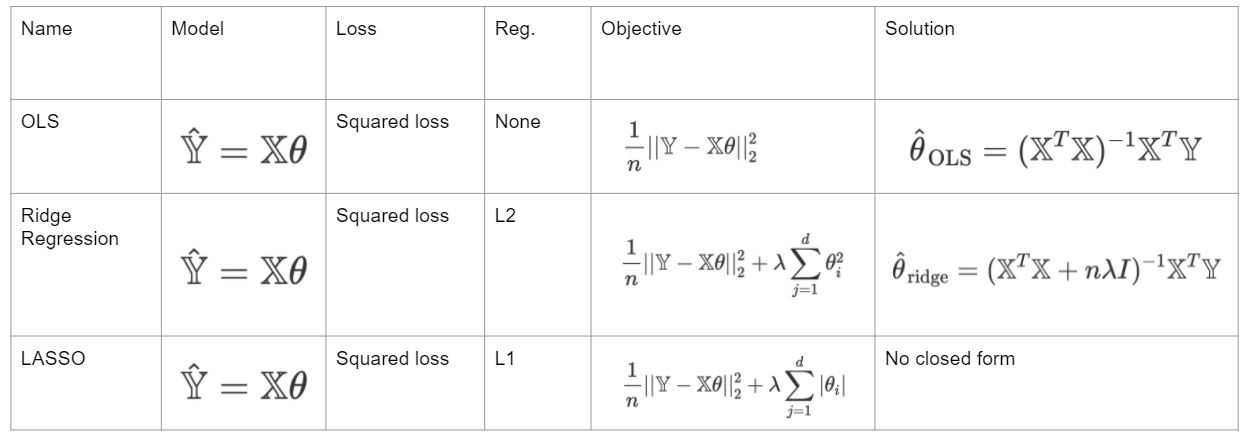
Model: Y = X * theta
Loss: Squared Loss
Regularization: L2 regularization
Objective Function Squared Loss + added penalty
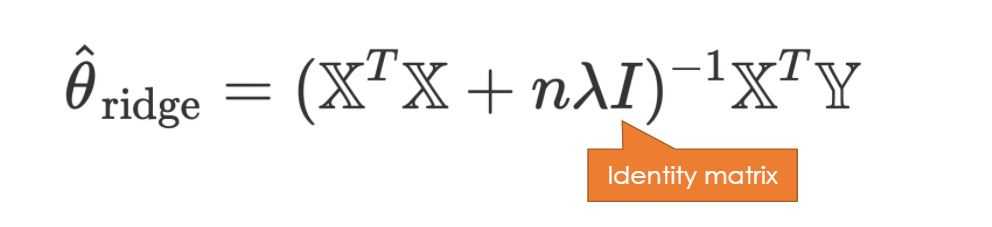
Note that there is always a unique optimal parameter vector for Ridge Regression!
Lasso Regression
Model: Y = X * theta
Loss: Squared Loss
Regularization: L2 regularization
Objective Function Average Squared Loss + added penalty
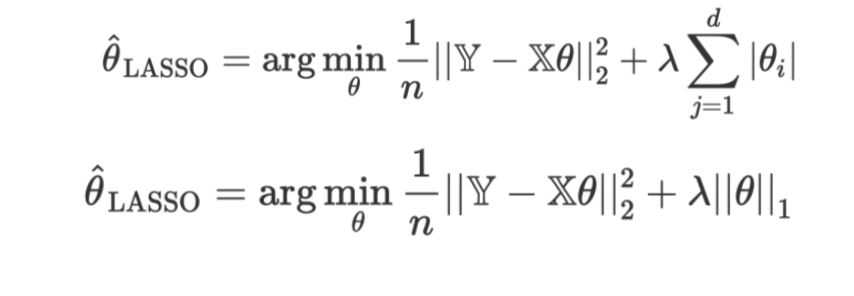
Note that there is NO closed form solution for the optimal parameter vector for LASSO so we must use numerical methods like gradient descent